


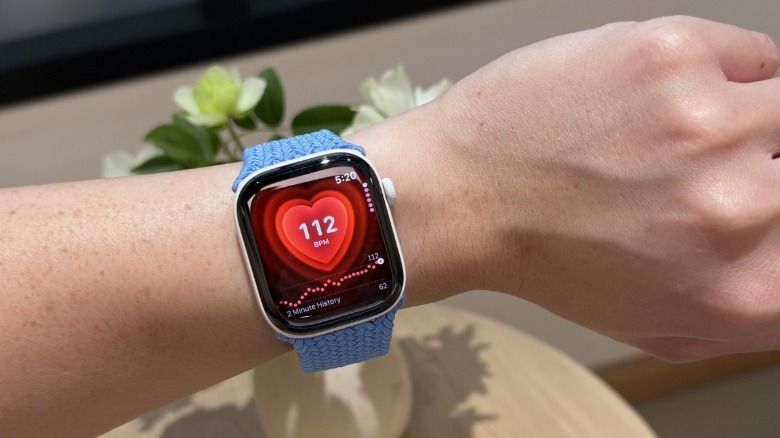
On to what else is new on the Apple Watch this year. At first glance, you probably won’t spot any difference between the Series 12 and Series 11. But depending on the model, one difference is quite evident. Apple has brought back a Ceramic case option, which is available in white or blue. I love this, especially the lighter shade, as the combination of material and finish just looks and feels unique in the land of metallic smartwatches.
The company also upgraded the protective covering on the screen on the aluminum versions, giving them the Ceramic Shield 2 that is also on the iPhone 18 Pro. The other two case types (Titanium and Ceramic) have sapphire-crystal displays like previous higher end Apple Watches do. On the aluminum series, there’s a new “dark bronze” color in addition to the black, space gray and light gold from before, while the titanium case comes in the familiar “natural” finish and a new “radiant gold.” Those who liked the “rose gold” hue of the last two generations will probably be disappointed, as there is no pinkish shade this year.
My review unit happens to be one of the dark bronze models, and because it’s darker than the space gray case of the Series 11 I’ve worn for a year, I initially thought it had thicker bezels. But the active area of the Series 12’s screen is still the same as its predecessor, and the case size is mostly the same too (the Ceramic case is slightly thicker). I point all that out simply to offer a word of advice: If bezels bother you, choosing a lighter case might make them seem smaller on the Series 12, especially if you’re coming from a relatively recent model of the Apple Watch.
The wholly upgraded health sensing system
Arguably the most significant upgrade to the Apple Watch Series 12 is its new “health sensing system,” which you can actually see on the underside. Apple increased the surface area (while maintaining the same footprint) that’s in contact with your skin, as well as the number of diodes, electrodes and LEDs that make up the heart rate detecting package. The components are all packed more closely together as well, and as a result of all these changes, Apple has been able to increase its accuracy and sampling rate, at little cost to battery life.
The change here is pretty significant. Before, background heart rate measurements were taken every five minutes, and on the Series 12, they’re happening every five seconds. HRV (heart rate variability) readings used to be taken every two to four hours or so, and on the latest Watch they’re recorded as often as every five minutes.
Apple also added a new variant of HRV readings. It used to only calculate SDNN (or Standard Deviation of NN intervals) values, which requires a larger sample size to be useful. But because it samples more frequently, the Series 12 enables Apple to calculate RMSSD (root mean square of successive differences) which can be more helpful in bursts like during or after workouts and training.
The new Readiness app and score
After I woke up the morning after my seventh night, I was informed that my Vitals were ready for viewing. In the week since Apple’s launch event, my sleep patterns have been all over the place. I’ve had two nights of “High” sleep scores, one at 91 and one at 80. My three nights in a row of “OK” results, ranging from 61 to 79, plus two nights of Low (41-60) and one night of Very Low meant I was prepared to see a lower baseline and general readiness results than I’m used to. (Product launch season always means less sleep and time to be at the gym.)
Accuracy and HRV
As for Apple’s claims that the improvements it made to the Series 12’s health sensing system make it the most accurate mainstream wearable, I can only really say that its readings in general come in within two beats per minute of the Fitbit Air that I wear basically all the time.
I do appreciate that I didn’t have to wait for seven nights before I could start seeing my HRV numbers, which I suspect might have something to do with the addition of those RMSSD readings. As someone who has recently started digging into her HRV stats, I’m pleased with this improvement. I also like the new heart rate complication enabled by this increased sampling frequency, as it saves me from having to press, swipe and look for the dedicated app just to find my exact beats per minute.
