


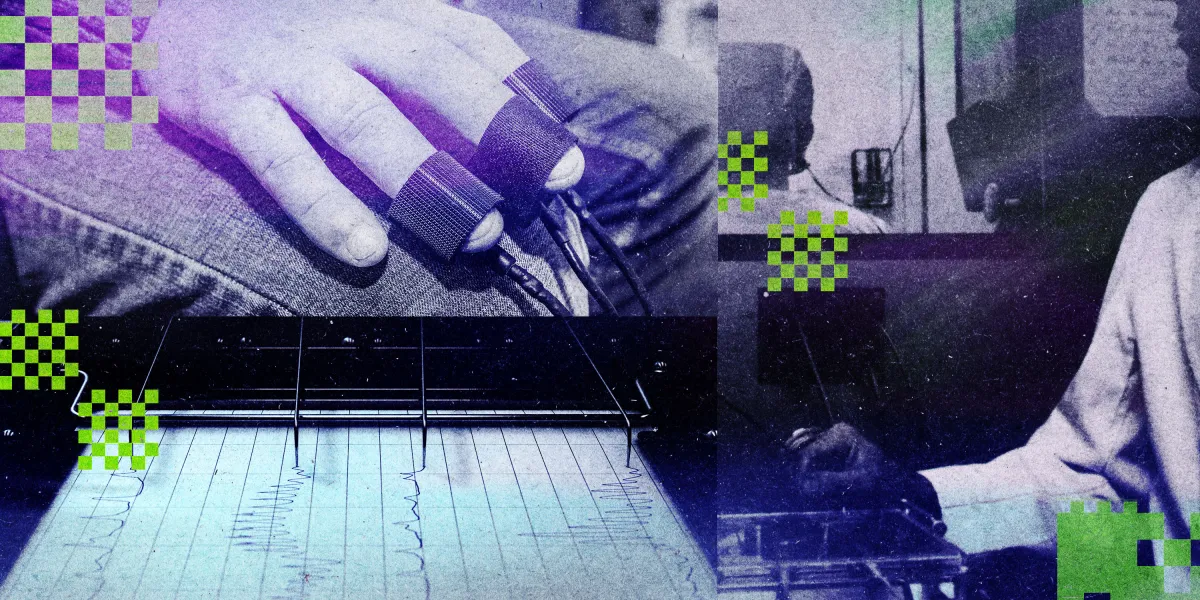
Various new strategies for lie detection have been attempted over the decades, with technologies ranging from thermal cameras to pupil trackers to brain scans. None of them have yielded reliable results outside the lab. The problem is that there’s no single telltale sign of lying that’s true for everyone all the time. “There is still no Pinocchio’s nose,” says van der Zee.
AI could theoretically improve polygraphs if it could find patterns in the data that examiners can’t. AI algorithms are also more likely to be used for “multi-modal” deception detection, which seeks to combine multiple measurements into an overall deception “score” that is harder for people to game. Three things are happening under the surface that lie detection tries to home in on, van der Zee says: physiological stress, cognitive load, and the conscious efforts people make to conceal the fact that they’re lying. Current polygraph technology tackles only one.
“The more you can have combined methods that approach it from these three different angles, the more successful you will be,” van der Zee says. This isn’t a new concept—in the 2000s, researchers at Manchester Metropolitan University in the UK developed a system called Silent Talker that generated a deception score from video footage. This was later folded into iBorderCtrl, an EU-funded pilot program. In the US, a project called AVATAR incorporated eye tracking, voice analysis, and body movement detection into a tool for use at border crossings. All these projects have quietly faded away.
Kotsoglou says combining AI and the polygraph is “the worst of both worlds” because it adds uncertainty on top of invalidity. Even if AI or machine learning can spot previously unseen patterns in physiological data, it won’t be able to reliably link them to lying because there is no real ground truth.
“Even if you have all the records in the world from polygraph tests, you don’t know whether those polygraph tests are right or not,” says Marion Oswald, a professor of law who has written with Kotsoglou on the use of polygraphs in the justice system. She fears that new forms of lie detection will, like the polygraph, be used more as a psychological prop than a scientific tool.
“It seems very much a response to the concern of the current administration to leaks and perceived lack of loyalty,” says Oswald. “[Lie detection is] being used as a threat, to intimidate and force people to confess to things, as opposed to anything that’s actually getting valid information.”
